Tips & Resources
How to Build an SEO PR Strategy That Elevates Brand Reputation

Updated: Published:
Discover the power of blending PR with SEO to create content that boosts reputation and ranks high. Learn how to effectively merge these two strategies to ensure digital marketing success.


Chris Norton
Chris Norton is the host of the UK’s 7th largest marketing podcast, Socially Unacceptable, and Founder of award-winning B2C specialist PR agency Prohibition.
Why blend PR strategy with SEO? When you merge these two powerful approaches, you create formidable content that doesn’t just boost your brand reputation—it also improves your search engine visibility.
So, how do you combine the two? This guide will teach you how to build an effective SEO PR strategy. But let's not get ahead of ourselves.
With SEO and PR actions combined, you can shape and share your brand’s story in a way that captivates your audience and catches the eye of search engines. With SEO PR as your digital megaphone, you can stand out and ensure your business’ success.
1. Conduct Keyword Research
Why start with keyword research? Because it’s like setting the GPS for your SEO PR journey. Knowing the right keywords is knowing the language of your audience and how they search for information related to your brand. You’ll later learn where you should use these as part of your SEO PR strategy. For now, just focus on creating a list of keywords.
To generate keyword ideas to include in your list, you need to understand your audience. Ask yourself: What is my audience searching for? What questions are they asking? It’s important to identify specific audiences and tailor your keyword research to address the unique needs and interests of each group.
Of course, with this approach alone, you’ll probably generate only a few keyword ideas. That’s where tools that can automate the research process come in handy.

There are numerous options available for keyword research. The good thing about tools like Google’s Keyword Planner (see above), SEMrush, Ubersuggest, or Ahrefs is that they offer other relevant insights apart from popular keywords. You can also get insights into search volume, keyword difficulty, and what your competitors are ranking for. That can help inform your keyword strategy, especially when targeting the right keywords for each audience segment.
For instance, you might decide to forgo trying to rank for a specific keyword even if it has a high search volume because of the high keyword difficulty. Or, you might include some keywords in your final list just because your competitor ranks for it.
A general recommendation is to look for long-tail keywords or specific phrases that your audience might use. These can be less competitive and are more targeted. When someone searches for “email marketing platforms for small businesses,” for instance, they’re looking specifically for these tools. So, if your product fits their criteria, it’s likely they’ll be interested and click on your content.
Once you have your list of keywords, set it aside for the time being. Mapping keywords to the stages of the customer journey ensures your content addresses users’ needs at every touchpoint.
2. Craft Compelling Content
At this point, you’ll need to create content that provides value to your audience. In particular, engaging content is essential to capture attention, drive higher engagement, and achieve better results. Whether it’s a blog post, landing page, press release, or blogs, your content should be optimized for both users and search engines, aligning with your keyword strategy. Remember, your goal is to boost your brand reputation and rank in search engine results pages with your content. You can’t do that if that content is mediocre.
Storytelling is a powerful tool in content creation. People connect with stories, not just facts. Actually, facts are approximately 22 times more likely to be remembered if they are part of a story. When creating content, ensure it resonates with your audience and supports your PR objectives.
So, when crafting your content, focus on telling your brand’s story, highlighting unique aspects that make you stand out. With excellent PR services, you can easily find that angle to focus on in your brand storytelling.
Nike is an example of a brand that knows how to tell stories. Notice how, instead of promoting and selling its Jordan Brand directly, it tells the beautiful narrative of how the shoe design came to life. Original research or stories created specifically for PR can also generate valuable media coverage and backlinks.


As a final tip, make sure your content is relevant to the keywords you came up with in the previous step. You’ll see why that’s important in the next section. You can use a generative AI platform for content ideas. Smart tools like this can also help you scale your content creation, while ensuring all your content pieces are on-brand. Consider incorporating high quality video content to further enhance your storytelling and audience engagement.
3. Optimize Content
Let’s assume you already have your high-quality content. Great! Now get that keyword list and start incorporating your keywords into it naturally. Avoid keyword stuffing. Instead, ensure the keywords are woven into the narrative. They shouldn’t sound forced.
Optimizing your content for SEO also means adding images, videos, or infographics that can make it engaging and shareable. Search engines tend to favor content with visuals and other multimedia elements like the one below as they enhance user experience (UX):

If you do incorporate these, make sure you create the important corresponding SEO elements like meta descriptions, title tags, and header tags. You’ll want to include your keywords in these elements, too. Optimizing for keyword rankings and search rankings helps you measure the effectiveness of your SEO PR strategy and track improvements in your position on the search engine results page (SERP).
As part of your optimization, pay attention as well to your content structure. Use clear headings and subheadings to make your content easy to understand. Employ bullet points when enumerating similar objects. Why are all these important? Well, again, they all help boost the user experience.
When linking, be sure to connect to other pages within your site as well as reputable external sources. This not only improves authority and user experience but also helps boost your site's domain authority.
Don’t forget to optimize for mobile as well. This is key to SEO since Google uses the mobile version of a site’s content for indexing and ranking. Besides, it’s good for conversions, too. People using mobile devices contribute to 56.2% of all website traffic. So, if you don’t ensure your content is mobile-friendly, you’ll miss out on organic traffic which you can convert into paying customers.
Once you’ve done all those, you can publish your optimized content on your site. Regularly adding new content is important to maintain and improve your search rankings over time.
4. Leverage Social Media Platforms
But don’t just rely on optimizing your blog post or press release with keywords to disseminate your brand message and secure good search engine rankings. You can leverage SMS link to promote your content, for instance. As part of your PR and SEO strategy, you can do the promotion on social media as well.
Social media is an invaluable tool in your SEO PR approach because of its reach. Just think about it. Over four billion people use social media. That’s a lot of people you can show your relevant content to.
The more people who see your valuable content, the greater the potential for link-building through social shares, which further strengthens your SEO PR approach. Also, the more people who are likely to link to that website content. After all, social media users exposed to your brand message may also include website administrators who can do this. Why bother with links? Because they can further boost your SEO efforts. High-quality backlinks, brand mentions, and media coverage are key SEO ranking factors that can result from viral or newsworthy content.
Then there’s the fact that on social media, you can build and nurture relationships. People you have relationships with are more likely to consume that content that enhances your reputation. They are also more likely to grant the favors you ask of them, like linking to your website content for SEO. Fostering community engagement through active participation in social groups or closed communities can boost your online visibility, nurture long-term brand advocates and strengthen your connection with your audience.
Note, though, that for this to work, you need to choose social channels where your target audience is most active. Also, you need to engage with your audience by responding to comments and participating in relevant conversations.
Does all this mean you can only use social media to share your optimized site content as part of your SEO PR strategy? Not really.
You can also post other types of content, as long as it reflects your brand message and generates engagement. Encouraging user generated content, such as customer stories or event highlights, can increase your reach and add authenticity to your brand.

Uber, for instance, uses its Instagram account to announce how it helps raise funds for ambulances. With this strategy, it doesn’t just help boost its reputation as a socially aware brand. As more people like and share the social media content, more website administrators are bound to take notice, go to the Uber website, and link to its other relevant posts. See how that approach to SEO PR can be just as effective?
Whatever you decide to post as part of your SEO and PR strategy, incorporate relevant keywords and hashtags into it. These help in making your posts even more discoverable both on social platforms and in search engines.
Also, keep track of what’s working and what’s not. Use analytics to understand your audience’s behavior and preferences. Track referral traffic from social media and other sites to measure the impact of your campaigns. This data can inform your future content and strategy, ensuring that your social media efforts are aligned with your PR and SEO goals. Additionally, leverage web analytics tools to monitor and optimize your social media and PR efforts for maximum effectiveness.
5. Use PR Outreach for Link-Building
Finally, for the best SEO and PR results, enhance your link-building efforts with PR outreach. Well-planned PR campaigns are designed to secure high-quality backlinks and media coverage for your company, helping to boost both authority and visibility in search results. The media, after all, can carry your relevant links in their articles as well, further boosting your backlink profile for SEO.
Start by identifying media outlets or journalists who cover your niche. When targeting high domain authority websites for outreach, you increase your chances of earning valuable backlinks and mentions. For this, you can check media databases like Prowly or Press Hunt. Another option is to search for articles related to your niche and to look at the bylines. You can use an email finder to search for your chosen media’s contact details.
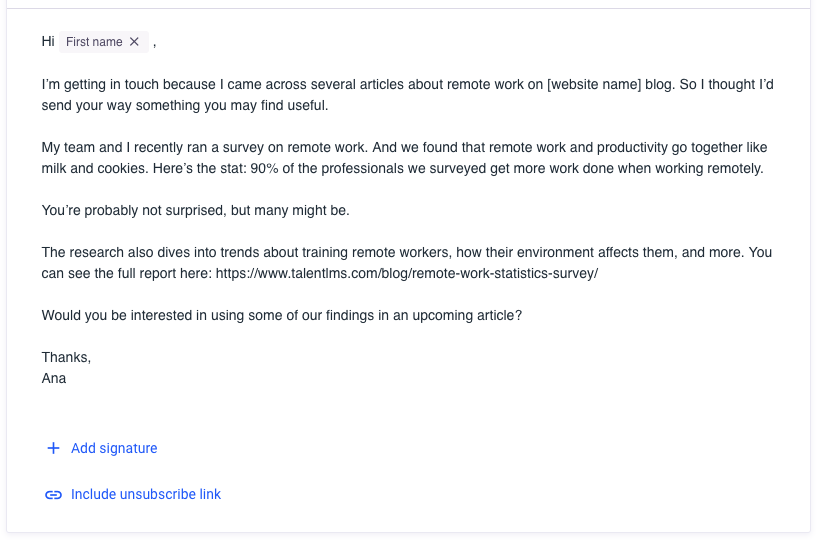
Once you have the details, reach out with your optimized site content. See below a sample email sent to a journalist as part of a company’s PR outreach:

As in the example above, ensure you personalize your communication. Explain why your content is relevant to their audience and how it adds value. Bland and generic pitches are less likely to be successful. If your content is valuable enough, they won’t hesitate to link to it in their articles. Earning brand mentions and links from reputable sites can significantly improve your online reputation and increase your visibility in search results.
Acquiring more links from authoritative sources provides a strong SEO benefit, as it aligns with Google's algorithms for ranking and helps your company achieve better organic performance.
Integrating PR and SEO outreach in this way makes sense for maximizing your brand’s online presence and authority.

Related articles

Tips & Resources
Driving More Online Bookings: SEO Techniques to Maximize Your Website's Visibility

29 August, 2023

Tips & Resources
6 ways PR can help you drive more bookings for your business
05 January, 2023